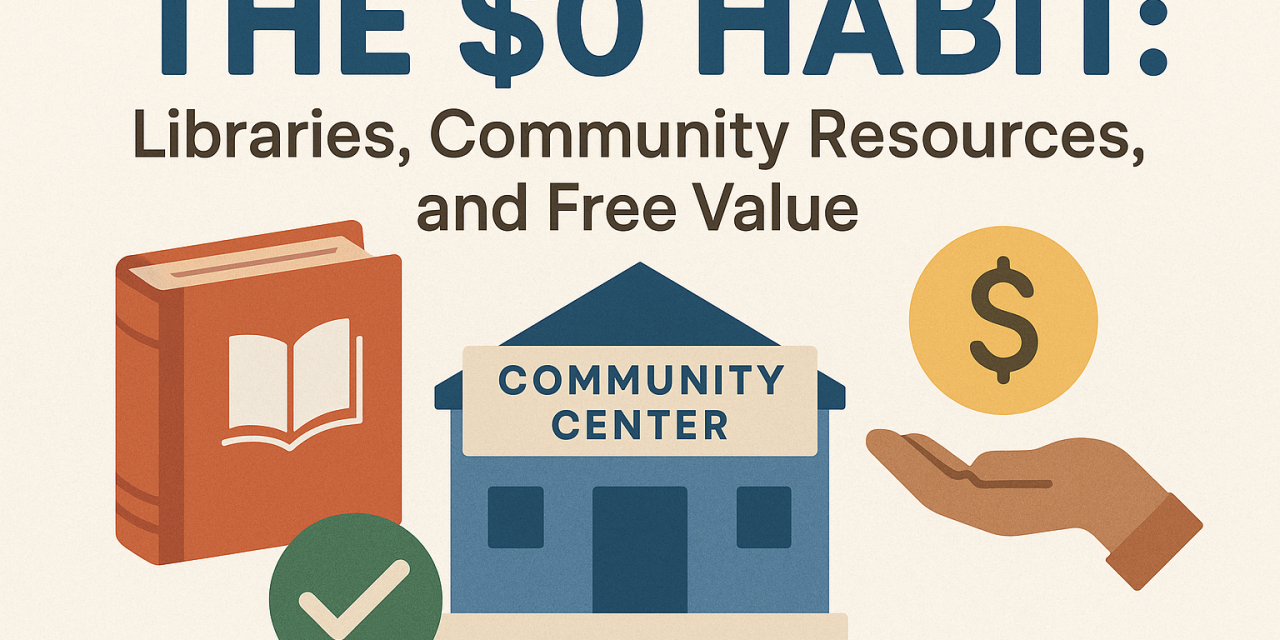
The $0 Habit: Libraries, Community Resources, and Free Value
How to learn more, create more, and live better—without spending more.
Why the $0 Habit Matters
- Compounding access: Small free wins (a book, a class, a tool) compound into skills, portfolio pieces, and opportunities.
- Choice over cost: When spending is optional, you choose for quality, not urgency or ads.
- Community strength: Using shared resources increases their funding, programming, and reach.
Libraries: Your $0 Headquarters
Modern public libraries are far beyond books. Explore and ask—many offers aren’t obvious from a quick visit.
High-Value Library Offers
- Books, eBooks, audiobooks, magazines, comics, and newspapers (often via dedicated apps).
- Streaming film, music, concerts, and language-learning platforms.
- Databases for business research, genealogy, market reports, practice tests, and academic journals.
- Maker spaces: 3D printers, sewing machines, laser cutters, recording booths, photo/film studios.
- Passes to museums, zoos, and cultural venues; local history rooms and archives.
- Study rooms, quiet floors, co-working tables, and proctored exam spaces.
- Kids’ storytime, teen clubs, adult education, author talks, and civic workshops.
- Seed libraries, community gardens, and tool-lending pilots.
Pro Tips to Maximize Value
- Get cards for every eligible system near you; many systems are reciprocal.
- Use holds, wishlists, and “suspend hold” to match your reading pace.
- Ask for interlibrary loan and “suggest a purchase”—librarians want circulation.
- Enable due-date reminders and auto-renew if available; explore fine policies.
- Take a 10-minute “tour” with a librarian to discover hidden resources.
Community Resources Beyond the Library
- Parks & Recreation: Free or low-cost classes, sports courts, nature centers, and volunteer days.
- Community Centers & YMCAs: Open gym hours, job boards, homework help, and occasional free days.
- Tool Libraries & Maker Clubs: Borrow drills, ladders, garden tools, or join open shop nights.
- Buy-Nothing & Swap Groups: Gift economies, clothing swaps, book exchanges, baby gear trades.
- Time Banks: Trade skills hour-for-hour—tutoring for bike repair, design for childcare.
- Extension & Adult Schools: Gardening, canning, finance, ESL, digital literacy, and certifications.
- Career & Small Business Hubs: Resume clinics, interview practice, mentorship, and legal clinics.
- Health & Wellbeing: Community clinics, meditation groups, running clubs, and peer support circles.
- Arts & Culture: Open mics, gallery nights, museum free days, community theater auditions.
- Mutual Aid & Community Fridges: Share food and essentials; give when you can, take when you need.
Free Value Online (Used Wisely)
- Open learning: Audit MOOCs, open courseware, open textbooks, and high-quality lectures.
- Public media: Podcasts and lectures from universities, museums, and local stations.
- Open-source tools: Office suites, coding languages, creative apps, and design assets.
- Freemium with guardrails: Track trial end dates; prefer services not requiring credit cards.
- Privacy basics: Use a dedicated “freebies” email, a password manager, and calendar reminders.
Build the $0 Habit
Weekly Rhythm
- Sunday (Plan): Add holds, schedule one event, set one learning goal.
- Midweek (Refuel): Pick up holds, attend a free class, review your 30-day list before buying anything.
- Weekend (Make): Use maker space time or a tool library item to complete a small project.
Borrow–Barter–Build Decision Tree
- Borrow: If you’ll use it ≤3 times this year, borrow from a library, neighbor, or tool share.
- Barter: If you have a skill others want, trade time or tutoring.
- Build: If it’s knowledge, find an open course, practice set, or community mentor.
Friction Reducers
- Save searches, authors, and series; set alerts for new releases.
- Keep a shared family “Hold Queue” and a “To Learn” list.
- Batch errands: library + park + community center in one loop.
The 30-Day $0 Challenge
- Day 1: Get or renew your library card. Explore the library’s digital apps.
- Day 2: Create a 30-day “Buy Later” list. Add anything you want to purchase.
- Day 3: Join one local exchange (tool library, time bank, or swap group).
- Day 4: Place three holds aligned to a goal (career, creative, wellness).
- Day 5: Attend one free community program.
- Days 6–10: Replace one paid habit (streaming, magazine, app) with a library or open alternative.
- Days 11–15: Start a micro-project using borrowed tools or a maker space.
- Days 16–20: Take a free course module; produce one tangible output.
- Days 21–25: Gift or trade an item/skill you’re not using.
- Days 26–29: Share your project at an open mic, show-and-tell, or online portfolio.
- Day 30: Review your “Buy Later” list. Delete what no longer matters. Celebrate the savings.
Track it: Log each free resource used, estimate the retail value you avoided, and total it weekly. Note the best outcomes (skills, connections, portfolio pieces) not just dollars.
Helpful Scripts and Templates
Email a Librarian
Subject: Quick help finding resources on [topic]


Hi [Name/Library Team],

I’m working on [goal]. Could you recommend books, databases, or events that would help?

If possible, could you also suggest any maker space or local partner resources?

Thanks so much!

[Your Name]
Borrow-from-a-Neighbor
Hey [Name], do you happen to have a [tool/item] I could borrow for [date range]?

I can trade [skill/time/help] in return. Totally fine if not!
Event Ask
Hi [Coordinator],

Would you consider hosting a free workshop on [topic]? I can help recruit attendees and volunteer on the day.
Applying the $0 Habit to Your Life
- Students: Use databases, citation tools, and study rooms; join study groups and tutoring hours.
- Job Seekers: Resume labs, mock interviews, certifications, and co-working spaces.
- Parents: Storytime, homework help, museum passes, and maker days.
- Creators: Recording booths, photo studios, design software access, and critique circles.
- Entrepreneurs: Market research databases, legal clinics, mentorship, and pitch nights.
Etiquette, Safety, and Sustainability
- Return items on time and in good condition; follow maker space rules.
- Mind privacy: use strong passwords, opt out of unnecessary data sharing, and avoid shady downloads.
- Be generous: volunteer, leave reviews, donate unused items, and teach what you learn.
- Respect capacity: community resources run on limited staff and budgets—patience and kindness go far.
FAQ
Is this just being “cheap”?
No. It’s about using what your community has already funded, so we all get more learning, connection, and resilience per dollar.
What if my local options are limited?
Check neighboring library systems, county resources, colleges, and state libraries. Many services are available online and open to non-residents.
How do I keep from getting overwhelmed?
Pick one goal per month, and choose three resources to support it. Repeat next month.