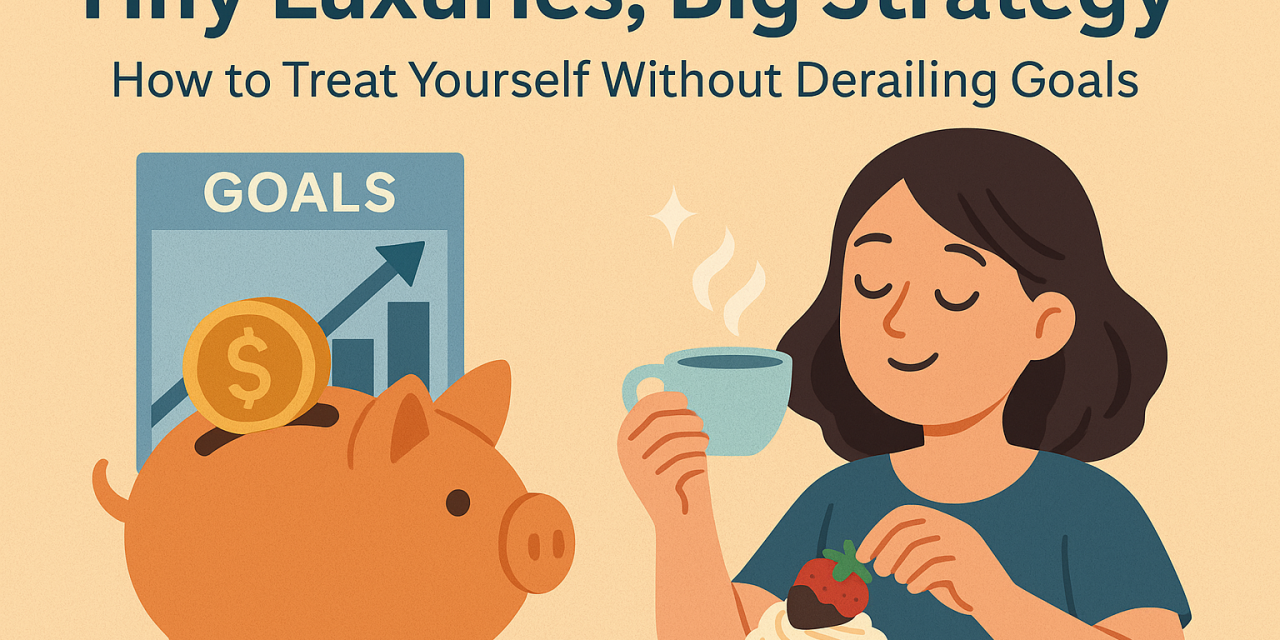
Tiny Luxuries, Big Strategy: How to Treat Yourself Without Derailing Goals
You want progress and pleasure at the same time. You want a night out and a bigger savings balance. You want a latte and a paid-off credit card. You do not need to choose one path. You need structure, timing, and a few simple rules. This guide gives you a plan that fits late 20s and early 30s life. You work hard. You face rent, loans, friendships, and family pulls. Treats help you stay motivated. A smart system keeps treats in bounds.
Define Tiny Luxuries With Numbers
Tiny luxuries are small discretionary buys that feel good and fit in a week. Think coffee, nicer takeout, rideshare on a rainy day, a streaming add-on, a boutique fitness class, better skincare, a game expansion, a premium app. Put a number on it. For most people, a tiny luxury sits in the 5 to 40 dollar range per item. The point is frequency control. One 25 dollar treat each week totals about 100 dollars a month. Three 15 dollar treats each week total about 180 dollars a month. You decide the level. Then you lock it in.
Set Guardrails First
Lock core goals before you touch treats. Use this order.
1. Minimum debt payments, on time, every month.
2. Emergency cash target, three to five months of expenses over time.
3. Retirement saving rate target, at least enough to get a full employer match if one exists.
4. High interest debt payoff plan, steady monthly extra amount.
After these, set a Treat Budget. Start with 1 to 3 percent of your monthly take-home pay. Examples:
• Take-home 3,500 dollars, treat budget 35 to 105 dollars.
• Take-home 5,000 dollars, treat budget 50 to 150 dollars.
• Take-home 7,500 dollars, treat budget 75 to 225 dollars.
Pick one number and automate it. The Guardrails order protects your goals. The Treat Budget gives you freedom inside a clear box.
Build a Treat Rulebook
Rules reduce stress and limit impulse waste. Use these.
• One treat day per week. You decide which day. Spend from the treat budget only on that day.
• One-in, one-out for subscriptions. Add a new five to fifteen dollar subscription only if one leaves.
• Weekly cap. Set a weekly limit equal to one quarter of your monthly treat budget.
• Receipt snapshot habit. Snap a photo after each treat. Drop it in a Treat album for quick tracking.
• No split between card types. Use one card or a prepaid wallet for every treat. Simplicity beats guesswork.
Use Systems That Do The Work
Rely on automation and friction.
• Open a “Treats” subaccount or digital wallet. Move the full monthly treat budget on payday. When the balance hits zero, treats pause until the next payday.
• Turn on round-ups into the Treats wallet if your bank supports it. Small daily transfers refill the pool.
• Use a reloadable gift card for your favorite coffee spot or market. Load the month’s treat amount once. No top-ups mid month.
• Create a phone shortcut that shows your Treats balance on your home screen.
Pick Luxuries That Punch Above Their Price
Buy items that return high value per dollar. Use cost per hour.
Cost per hour equals price divided by hours of use or enjoyment in the first month.
Examples:
• 20 dollar premium app used 20 hours this month, cost per hour equals 1 dollar.
• 30 dollar boutique class enjoyed 1.5 hours with strong mood lift the rest of the day, call it 3 hours of impact, cost per hour equals 10 dollars.
• 18 dollar movie with friends, 2.5 hours, cost per hour equals 7.20 dollars.
• 25 dollar skincare product used daily for 30 days, about 30 uses, cost per use equals 0.83 dollars.
Pick the lowest cost per hour that still feels good. Rotate choices to avoid habit creep.
Time Luxuries For Maximum Effect
Match treats with moments when they do the most for mood and momentum.
• Milestone timing. Tie treats to wins, like finishing a project or hitting a gym streak. You earn the treat and lock a memory with it.
• Off-peak timing. Lunch specials, weekday matinees, shoulder season travel. The same joy, lower cost.
• Stack small discounts. Loyalty points, credit card offers, store coupons. Plan one treat day to use them together.
• Social timing. Share a pricier treat with friends and split the cost. One dessert and three spoons beats three desserts.
Keep Big Goals In View
Translate big goals into monthly targets, then protect those targets.
• Vacation. Goal 2,500 dollars in 10 months. Monthly target 250 dollars. Treat budget stays separate and lower, so the trip fund stays on pace.
• Emergency fund. Goal 9,000 dollars. Save 500 dollars per month. In 18 months you reach 9,000 dollars. Do not pull from this for treats.
• Student loans or credit cards. Pick a fixed extra payment, like 150 dollars per month on top of the minimum. Add a small bonus payment when you get a raise or tax refund. Treats never reduce the extra payment.
Place these monthly targets at the top of your budget. Treats use what remains after those transfers leave your checking account.
Audit And Adjust In 20 Minutes Each Month
Run a quick review once per month.
1. Open your Treats wallet, note last month’s total and number of treats.
2. Mark the three best and the three weakest. Keep the best. Replace the weakest with a different option, or skip them.
3. Check big goals. If any target fell short, trim next month’s treat budget by 10 to 20 percent until you recover.
4. Set one treat experiment for next month, like a library card plus a new recipe night, or a day pass to a public pool.
5. Move the new month’s treat amount on payday and update the phone widget.
Scripts, Not Willpower
Use cues and rules to avoid decision fatigue.
• The 24-hour hold. If an item costs more than one week of your treat budget, add it to a list and wait 24 hours. Buy only if it still ranks top three for next week.
• The swap script. If you want a treat after the wallet hits zero, pick one planned treat later this month and cancel it. No extra money moves in.
• The price anchor. Before checkout, speak a number that equals your hourly rate after tax. If the treat costs more than two hours of take-home pay, move it to a wish list for next month’s plan.
• The receipt rule. No receipt photo, no treat. That one step slows you down enough to think.
Health And Time Treats Beat Stuff Treats
Buy relief, not clutter. A 20 dollar upgrade to sleep or recovery often beats a 20 dollar trinket. Examples:
• Better pillow insert or eye mask for sleep.
• Precut veggies and rotisserie chicken for a fast, healthy dinner at home.
• A one day laundry service pick-up during a packed week.
• A day pass to a gym with a sauna, stretch, and relax.
• A therapy copay if covered, or a group session with a sliding scale provider.
Adults do well with 7 to 9 hours of sleep per night. Support that window with small upgrades. Fatigue leads to impulse buys and missed workouts. Treats that protect rest pay you back in steady habits.
Examples By Income Level
Three case studies show how it looks.
Case A, monthly take-home 3,500 dollars.
• Big goals, 500 to emergency fund, 150 extra to a credit card, 200 to Roth IRA or workplace plan beyond match.
• Treat budget 70 dollars, 2 percent.
• Plan, Two 20 dollar social treats and three 10 dollar solo treats. 60 dollars total, 10 dollars buffer.
Case B, monthly take-home 5,000 dollars.
• Big goals, 700 to house down payment fund, 200 extra to student loans, 300 to Roth IRA or workplace plan beyond match.
• Treat budget 100 dollars, 2 percent.
• Plan, One 35 dollar dinner, two 15 dollar coffees, one 25 dollar class, one 10 dollar app. 100 dollars total.
Case C, monthly take-home 7,500 dollars.
• Big goals, 1,000 to house fund, 300 extra to loans, 500 to retirement, 200 to future travel.
• Treat budget 150 dollars, 2 percent.
• Plan, One 50 dollar date night, one 40 dollar skincare item, two 15 dollar coffees, one 20 dollar movie with popcorn, one 10 dollar app. 150 dollars total.
Stop Lifestyle Creep Before It Starts
New income invites new habits. Use ceilings.
• Keep the treat budget at a fixed percent, do not let it float above 3 percent without a plan.
• Hold subscriptions to a set count. Example, three services total across music, video, and fitness.
• Keep one luxury category permanent and rotate the rest. Example, always pay for high quality running shoes, rotate other treats each quarter.
Use Micro-savings To Fund Treats
Small automations fund small joys without hurting goals.
• Redirect cash-back or card rewards into the Treats wallet monthly.
• Sell one unused item per month. Send the full proceeds to Treats or to a goal, decide in advance.
• Turn on bill alerts and renegotiate one bill per quarter, like internet or mobile. Split the savings, half to Treats, half to debt or savings.
When Income Drops Or Costs Jump
Life shifts. Keep the system and scale the treat budget, not the rules.
• Move to 0.5 to 1 percent of take-home for three months.
• Swap pricier treats for low or no cost treats. Library holds, park days, free museum nights, community workouts.
• Keep one spirit-lifting ritual, like a weekly pastry, to protect morale.
• Resume the prior percent only after big goals sit back on track for two months.
Keep Score Without Stress
Use a simple tracker.
• Columns, Date, Item, Price, Minutes of Joy, Would Repeat, Y or N.
• Rate each treat from 1 to 5 on Minutes of Joy value, quick gut score.
• Delete any treat that scores 1 or 2 twice. Keep high scorers and repeat them on milestone days.
• Review monthly and update the plan.
Sample Social Media Posts You Can Use
Copy, edit, and share. Keep friends in the loop and stay accountable.
• I set a Treat Budget at 2 percent of take-home. One card for all treats. When it is empty, I pause. Joy with guardrails.
• Cost per hour test for every luxury. Price divided by hours of use. Low score wins the month.
• One-in, one-out subscriptions. Three total across music, video, fitness. New one, old one leaves.
• 24-hour hold rule for items over one week of treat money. If it still ranks top three tomorrow, I buy.
• Monthly audit, 20 minutes. Keep top three treats, cut the weakest three. Goals stay on pace.
A One-Page Setup Checklist
1. Pick your Treat Budget percent, 1 to 3 percent of take-home.
2. Open a Treats wallet or subaccount, set an automatic transfer on payday.
3. Choose one treat day per week and one payment method.
4. Write three high-value treats and three low-value treats from last month. Keep the winners.
5. Add a phone widget or shortcut with your Treats balance.
6. Set a 20-minute monthly audit reminder on your calendar.
7. End each month with a top three treats list for the next month.
Bring It Together
Tiny luxuries keep you steady. A clear percent, a separate wallet, and a short rulebook protect your bigger goals. You spend on what lifts you up and pass on what drains your budget. You set a rhythm that feels human. Progress continues. Treats stay guilt free. Your future self gets funded, and your present self smiles on the way there.