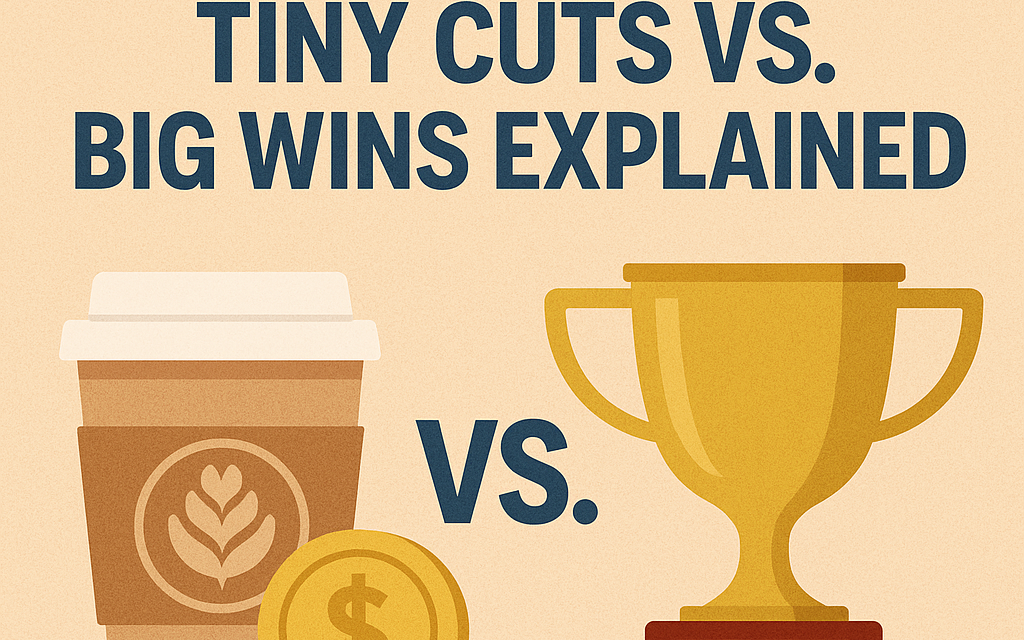
The Latte Debate Is Over: Tiny Cuts vs. Big Wins Explained
Why This Matters In Your Late 20s And Early 30s
You face big money moves right now. Salary steps. Housing choices. Debt cleanups. Small habits still matter, but the order of operations sets the pace. Focus on high-impact levers first, then sweep up the small leaks. This approach grows savings faster, lowers stress, and builds margin for goals like travel, kids, a home down payment, or work flexibility.
Tiny Cuts Defined
Tiny cuts are daily or weekly trims. Think coffee, takeout, ride shares, subscriptions, and impulse buys. These changes lift savings gradually. They build discipline and keep spending intentional. They also free cash for bigger targets.
Examples:
– Coffee at 5 dollars on weekdays equals about 1,300 dollars per year.
– Two takeout meals per week at 20 dollars each equals about 2,080 dollars per year.
– Three unused subscriptions at 10 dollars each equals 360 dollars per year.
These sums help. They move the needle when stacked and routed into savings or debt payoff.
Big Wins Defined
Big wins reshape your baseline. They repeat month after month with little effort once set.
Examples:
– Income moves like a raise, a promotion, or a higher paying role.
– Housing choices such as rooming with a friend, moving one stop farther, or negotiating renewal.
– Transportation choices like keeping a paid‑off car, buying reliable used, or dropping to one car in a two‑adult household.
– Benefits optimization such as grabbing the full 401(k) match, picking a smarter health plan, or opening an HSA when eligible.
– Debt interest reduction through 0 percent balance transfers, refinancing student loans, or paying off high APR cards.
These moves swing thousands per year, sometimes tens of thousands over a few years.
Numbers That Settle It
Coffee example. Five dollars per weekday equals 1,300 dollars per year. Invest 1,300 dollars per year at a 7 percent average return for 10 years. Result sits near 18,000 dollars. Solid progress.
Raise example. Salary at 80,000 dollars. A 10 percent raise adds 8,000 dollars in year one. Assume 3 percent annual cost‑of‑living increases after that. Extra pay stacks each year. Over 10 years the raise adds about 92,000 dollars before taxes. Assume a 35 percent total tax load. Net near 60,000 dollars. This single move beats a decade of latte trims invested at 7 percent.
Housing example. Drop rent by 250 dollars per month. Save 3,000 dollars per year, after tax. Over three years, 9,000 dollars. Invest along the way and the gap widens.
Debt example. A 5,000 dollar card at 20 percent APR burns about 1,000 dollars per year in interest. Pay it off and you free that cash every year going forward.
Investment fees example. A 50,000 dollar index fund at a 0.05 percent expense ratio grows near 98,000 dollars over 10 years at a 6.95 percent net return. The same money in a 1 percent fee fund grows near 89,600 dollars at a 6 percent net return. Difference near 8,400 dollars. Same market, different outcome.
The pattern stays clear. Tiny cuts help, big wins dominate.
When Tiny Cuts Win
– You need quick momentum. A few early wins raise confidence.
– You want cash right now for a high‑APR payoff.
– Habits feel loose. A weekly cap on takeout, bars, and ride shares adds guardrails.
– You aim to free 100 to 300 dollars per month to hit a minimum 401(k) match or start an emergency fund.
Tactics that work:
– Set a weekly discretionary cap and pre‑load it on a debit card.
– Batch cook two anchor meals on Sunday for weekday dinners.
– Audit subscriptions every quarter. Kill everything you did not use in the past 30 days.
– Move all impulse triggers off your phone home screen.
When Big Wins Win
– Your top three costs, housing, transportation, taxes, dominate the budget.
– You hold high‑interest debt.
– You leave free money on the table, like an employer match.
– You expect a comp review in the next 90 days.
– You face a lease renewal.
Go straight at these. One hour of effort here often equals months of latte savings.
A Practical Stack: Order Of Operations
1) Stop the bleeding
– Bring current all bills. Avoid late fees.
– Pause discretionary splurges for 30 days. Build a 1,000 dollar buffer.
2) Grab free returns
– Contribute enough to secure the full 401(k) match.
– Open a high‑yield savings account for your buffer fund.
3) Crush expensive debt
– Move card balances to 0 percent transfer offers when fees make sense.
– Pay balances in order of APR, highest first. Automate minimums on the rest.
4) Lower fixed costs
– Negotiate rent or move at renewal. Target 5 to 10 percent lower housing cost.
– Switch auto insurance after quotes from at least three carriers.
– Pick a health plan that fits your actual care pattern. Run total cost, premium plus expected out‑of‑pocket.
5) Grow income
– Plan and execute a raise or role upgrade.
– Pick up overtime or project‑based pay that ties to your full‑time path.
6) Optimize investing
– Use broad index funds with low fees.
– Raise your savings rate 1 percent of pay every quarter until you hit your target.
Your 12‑Month Playbook
Month 1
– Build a 1,000 dollar starter fund.
– List debts, balances, APRs, minimums.
– Pull your benefits guide. Mark the 401(k) match rules.
Months 2 to 3
– Hit the full match.
– Refinance or transfer high APR card debt where math supports it.
– Get three auto and renters insurance quotes. Lock lower rates.
Months 4 to 6
– Prepare a raise conversation. Track wins, revenue, savings, quality metrics.
– Time the talk two weeks before comp decisions.
– If blocked, set a timeline for a job search.
Months 7 to 9
– Review housing. Compare renewal rent to realistic alternatives. Factor commute time and quality of life.
– Trim transportation. Keep the paid‑off car. If buying, target a reliable used model, total cost under 10 percent of gross income for each year of ownership.
Months 10 to 12
– Raise your 401(k) or IRA contributions by 2 to 4 percentage points if debt is under control.
– Fund an HSA if eligible. Leave the money invested for long‑term health costs.
– Build your emergency fund toward three to six months of expenses.
Scripts And Templates For Big Wins
Salary script
Hi [Manager],
I appreciate your support this year. Here are outcomes from the last two quarters.
– Reduced onboarding time by 22 percent, saving 120 hours across teams.
– Closed 1.1 million dollars in new revenue.
– Shipped [Project] two weeks early with zero defects.
Market data shows roles like mine at 90,000 to 100,000 dollars. My current pay sits at 82,000 dollars. I am asking for 92,000 dollars to match scope and results. I am ready to take on [next responsibility] to raise impact.
Thanks for reviewing this request.
Rent renewal script
Hi [Landlord],
I value the apartment and always pay on time. Nearby units list at 2,150 dollars. My current rent is 2,200 dollars. I will renew for 12 months at 2,100 dollars and sign this week.
Thank you.
Insurance quote call
I am shopping for auto and renters together. I need replacement cost on renters, 100k, 300k liability on auto, and uninsured motorist coverage. Please quote with a 1,000 dollar deductible and a 500 dollar deductible. Email the breakdown.
Student loan refinance email
My balance is 28,000 dollars at 7 percent. I have a 760 credit score, stable income, and no late payments. Please share term options at fixed rates and all fees in writing.
Social Media Post Templates
– Tiny cuts help, big wins dominate. Grab the full 401(k) match, then cut takeout.
– Ask for a 10 percent raise. A 10 percent raise on 80k often beats a decade of latte trims.
– Lower rent by 250 dollars per month. Bank 3,000 dollars per year without fuss.
– Kill 20 percent APR debt. Free 1,000 dollars per year for every 5,000 dollars paid off.
– Switch to low‑fee index funds. Keep more of your returns.
– Build a 1,000 dollar buffer. Avoid overdrafts and late fees.
Tools And Habit Loops
– Paycheck splits. Route a fixed percent to savings and investments on payday.
– Calendar blocks. Money hour every Sunday. Pay bills, review transactions, set next week’s caps.
– Merchant rules. Turn off one‑click checkout. Delete saved cards on shopping sites.
– Price anchors. Before buying, compare total hours of work needed after tax. Use your real hourly rate, pay after taxes and deductions.
– Default raises. Increase 401(k) by 1 percent every quarter until you reach the goal.
Case Studies
Case A, renter with credit card debt
– Income 75,000 dollars. Rent 1,900 dollars. Card debt 7,500 dollars at 21 percent APR.
– Steps. Full 401(k) match at 4 percent. 0 percent transfer with a 3 percent fee for 12 months, fee equals 225 dollars. Aggressive payoff at 800 dollars per month, card gone in 10 months. Negotiate rent down 100 dollars at renewal. Net outcome in year one, 7,500 dollars debt cleared, interest saved near 1,400 dollars, rent savings 1,200 dollars, retirement contributions 3,000 dollars plus match.
Case B, early parent, one car change
– Income 120,000 dollars household. Two cars with payments at 450 and 420 dollars. Insurance 220 dollars per month.
– Steps. Sell the higher payment car. Buy a 9,000 dollar used model in cash from savings and a small side sale of unused items. New insurance after quotes lowers total to 150 dollars per month. Net outcome, payments drop by 420 dollars, insurance drops by 70 dollars. Annual savings near 5,880 dollars, before fuel differences.
Case C, job switch with higher base
– Income 92,000 dollars, market rate 105,000 to 120,000 dollars.
– Steps. Three months of targeted outreach, 30 tailored applications, 10 referrals, 6 screens, 3 panels, 1 offer at 112,000 dollars. Raise equals 20,000 dollars. After taxes near 13,000 dollars. Move 8,000 dollars to high‑interest debt payoff and 5,000 dollars to emergency fund. Savings rate lifts by 10 percentage points with no lifestyle downgrade.
Common Traps To Avoid
– Treating coffee as the enemy while ignoring rent and car payments.
– Skipping the employer match.
– Delaying a raise talk for perfection. Progress beats silence.
– Buying new cars with long terms. Interest and depreciation wipe cash flow.
– Letting subscriptions creep back after a purge.
– Chasing points with a balance. Rewards vanish once interest hits.
– Holding too much cash in a near‑zero account. Move long‑term cash to high‑yield savings, then to investments based on goals.
Quick Answers
– Small daily trims help discipline and fund debt payoff. They rarely drive large wealth alone.
– Big wins set your baseline and compound. Prioritize these.
– Index funds with low fees support better outcomes than high‑fee funds over time.
– A raise early in your career echoes for decades, because each future increase stacks on a higher base.
– Housing choice is the quiet giant in most budgets.
– High‑APR debt erodes progress faster than most new savers expect.
Next Steps
– Pick one big win to pursue this week. Raise, lease decision, debt move, or benefits change.
– Pick two tiny cuts to free 100 to 200 dollars per month.
– Automate transfers to investments and savings on payday.
– Book a 30‑minute block each week for review and one decision.
– Track your savings rate monthly. Aim for a clear target. Many late‑20s and early‑30s savers hit 15 to 25 percent after these moves.
The latte debate helped people notice small leaks. Your next level sits with system choices. Nail one big lever, then stack habits. You build a resilient money setup, one decision at a time.